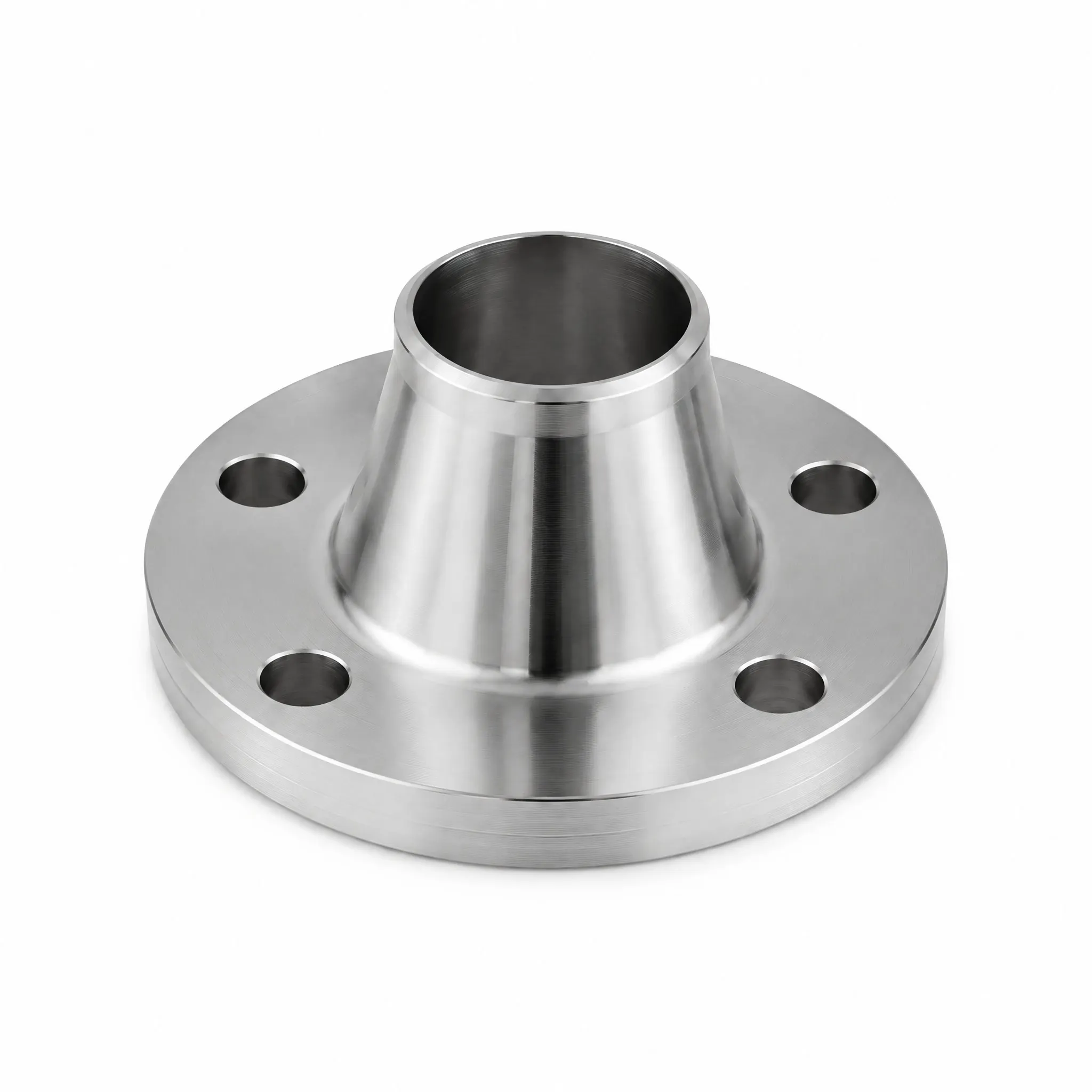
What Is an ASME B16.5 Weld Neck Flange?
A weld neck (WN) flange is a butt-welding flange with a long tapered hub that joins the pipe by a single full-penetration butt weld. Covered by ASME B16.5, it is the highest-integrity flange type for high-pressure, high-temperature and cyclic service, because the tapered hub distributes stress into the piping and the weld can be 100% radiographically examined.
Size & Pressure Class Range
- Sizes: NPS 1/2 through NPS 24 (Class 150–1500); NPS 1/2 through NPS 12 (Class 2500), per ASME B16.5-2025 scope
- Pressure classes: Class 150, 300, 400, 600, 900, 1500, 2500
- Connection: butt-welding end matching pipe OD and schedule
Pressure-Temperature Ratings (Group 1.1 Carbon Steel, at 38°C)
| Class | 150 | 300 | 400 | 600 | 900 | 1500 | 2500 |
|---|---|---|---|---|---|---|---|
| Rating, bar | 19.6 | 51.0 | 68.0 | 102.0 | 153.1 | 255.1 | 425.1 |
Exact ratings at other temperatures follow ASME B16.5 Table 2-1.1 for your material group.
Materials & Temperature Limits
| Material | Grade | Temperature Range |
|---|---|---|
| ASTM A105 | Carbon steel forging | -29°C to 425°C (graphitization limit) |
| ASTM A182 | F304 / F304L / F316 / F316L | Up to 538°C |
| ASTM A350 | LF2 | -46°C to 425°C (low-temperature service) |
WN Flange Dimensions — SI Units (mm)
Excerpted from ASME B16.5-2025. O = outside diameter of flange; tf = minimum flange thickness; X = diameter of hub; Y = length through hub (welding neck). Full tables for all classes and sizes per ASME B16.5-2025.
Class 150 (Table 8, SI)
| NPS | O (mm) | tf (mm) | X Hub (mm) | Y Through Hub (mm) |
|---|---|---|---|---|
| 1/2 | 89 | 9.7 | 30 | 46 |
| 1 | 108 | 12.7 | 49 | 54 |
| 2 | 152 | 17.5 | 78 | 62 |
| 4 | 229 | 22.4 | 135 | 75 |
| 6 | 279 | 23.9 | 192 | 87 |
| 8 | 343 | 26.9 | 246 | 100 |
| 12 | 483 | 30.2 | 365 | 113 |
| 16 | 597 | 35.1 | 457 | 125 |
| 24 | 813 | 46.0 | 663 | 151 |
Class 300 (Table 11, SI)
| NPS | O (mm) | tf (mm) | X Hub (mm) | Y Through Hub (mm) |
|---|---|---|---|---|
| 1/2 | 95 | 12.7 | 38 | 51 |
| 1 | 124 | 15.7 | 54 | 60 |
| 2 | 165 | 20.6 | 84 | 68 |
| 4 | 254 | 30.2 | 146 | 84 |
| 6 | 318 | 35.1 | 206 | 97 |
| 8 | 381 | 39.6 | 260 | 110 |
| 12 | 521 | 49.3 | 375 | 129 |
| 16 | 648 | 55.6 | 483 | 145 |
| 24 | 914 | 68.3 | 702 | 167 |
Class 600 (Table 16, SI, NPS 1-1/4 and above)
| NPS | O (mm) | tf (mm) | X Hub (mm) | Y Through Hub (mm) |
|---|---|---|---|---|
| 2 | 165 | 25.4 | 84 | 73 |
| 4 | 273 | 38.1 | 152 | 102 |
| 6 | 356 | 47.8 | 222 | 117 |
| 8 | 419 | 55.6 | 273 | 133 |
| 12 | 559 | 66.5 | 400 | 155 |
| 16 | 686 | 76.2 | 495 | 178 |
| 24 | 940 | 101.6 | 718 | 203 |
Standard bore B follows ASME B36.10M standard-wall pipe (Schedule 40 at NPS 10 and smaller). Full dimensional tables for Classes 400, 900, 1500 and 2500 are in ASME B16.5-2025 (Tables 14, 18, 20 and 22, SI units).
Related Standards
- ASME B16.5 — Pipe Flanges Overview (NPS 1/2–24)
- ASME B16.5 Slip-On Flanges
- ASME B16.5 Blind Flanges
- ASME B16.5 Lap Joint Flanges
- ASME B16.20 — Metallic Gaskets for Flanges
- Our Flange Range
- ASTM A105 Carbon Steel Forgings
FAQ
What is the advantage of a weld neck flange?
The long tapered hub distributes stress into the pipe wall, and the single butt weld can be radiographically examined. WN flanges are the preferred choice for high-pressure, high-temperature and thermal-cyclic service.
What sizes and classes does ASME B16.5 cover?
NPS 1/2 through NPS 24 in Classes 150–1500, and NPS 1/2 through NPS 12 in Class 2500, per the ASME B16.5-2025 scope. Larger diameters NPS 26–60 are covered by ASME B16.47.
What materials are standard for weld neck flanges?
Carbon steel A105 (-29°C to 425°C), stainless A182 F304/F316 and their low-carbon variants (up to 538°C), and low-temperature A350 LF2 (-46°C). Chemistry and mechanical properties per the respective ASTM specifications.
How do I match a WN flange to my pipe?
The welding-end bore and bevel are machined to match your pipe OD and schedule. Specify pipe size, schedule and flange class; we machine the bore and bevel to ASME B16.5 para. 6.7.
Is a weld neck flange stronger than a slip-on flange?
Yes. A slip-on flange needs two fillet welds and is limited to moderate service; the WN butt-welded joint carries higher and cyclic loads and is inspectable, which is why it is specified for critical service.