What Is an ASME B16.5 Blind Flange?
A blind flange is a flange with no bore — a solid disc used to seal the end of a piping system, a valve or a pressure vessel nozzle. Covered by ASME B16.5, it is bolted between two flanges (or onto a flange end) and carries the highest bending stress of any flange type, which is why blind flanges are relatively thick.
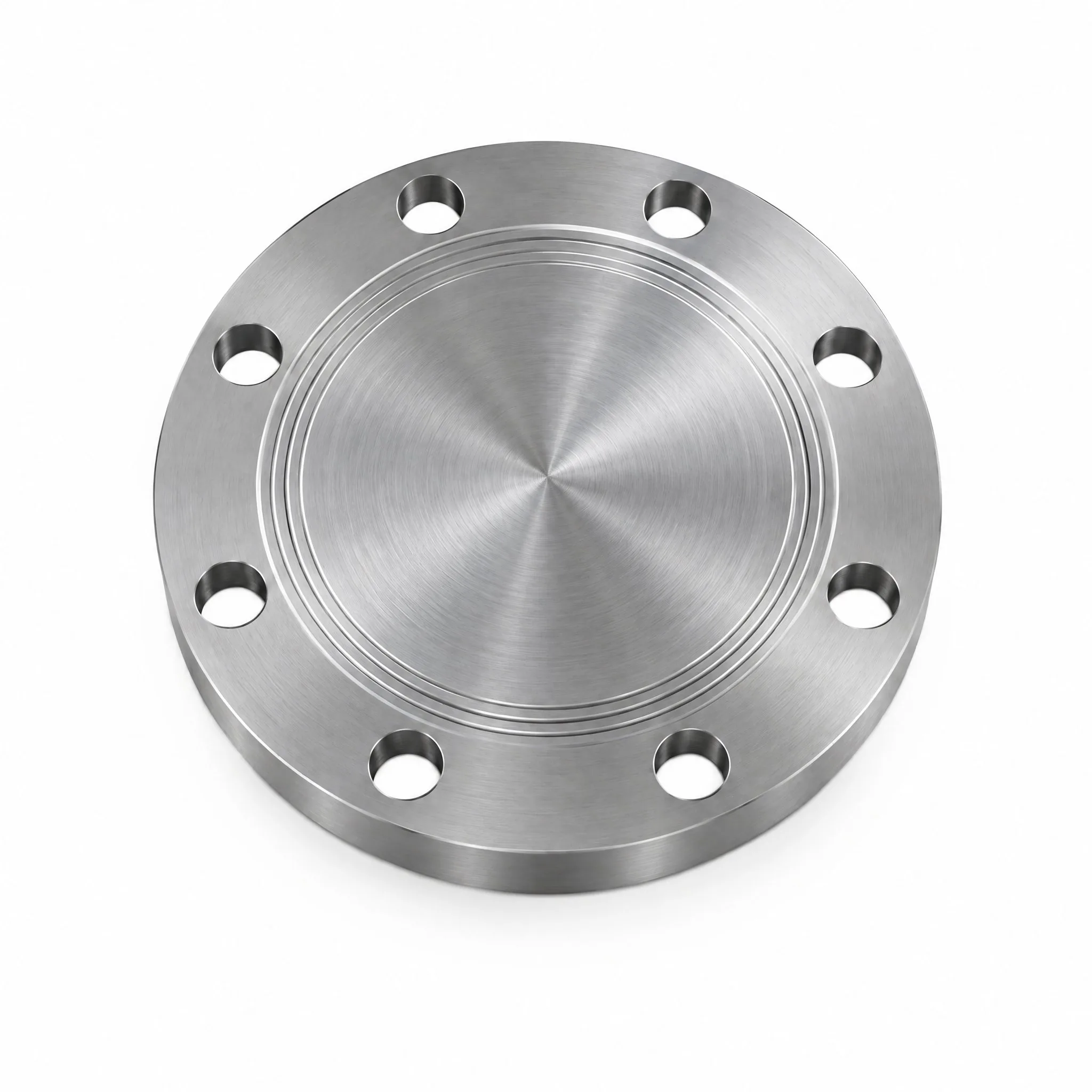
Size & Pressure Class Range
- Sizes: NPS 1/2 through NPS 24, in Classes 150 through 2500
- Connection: bolted between mating flanges; no pipe connection, no bore
- Construction: cast, forged or plate; may be made with or without a hub at the manufacturer’s option
Pressure-Temperature Ratings (Group 1.1 Carbon Steel, at 38°C)
| Class | 150 | 300 | 400 | 600 | 900 | 1500 | 2500 |
|---|---|---|---|---|---|---|---|
| Rating, bar | 19.6 | 51.0 | 68.0 | 102.0 | 153.1 | 255.1 | 425.1 |
Materials & Temperature Limits
| Material | Grade | Temperature Range |
|---|---|---|
| ASTM A105 | Carbon steel forging | -29°C to 425°C |
| ASTM A182 | F304 / F304L / F316 / F316L | Up to 538°C |
| ASTM A350 | LF2 | -46°C to 425°C (low-temperature service) |
Dimensions
Blind flange dimensions — outside diameter O, minimum thickness tf, bolt circle and bolt hole pattern — follow the same dimensional tables as the matching flanges in ASME B16.5-2025: Table 8 (Class 150), Table 11 (Class 300), Table 14 (Class 400), Table 16 (Class 600), Table 18 (Class 900), Table 20 (Class 1500) and Table 22 (Class 2500), SI units. The bolt circle and drilled holes match the weld neck or slip-on flange of the same size and class so that mating is interchangeable.
Related Standards
- ASME B16.5 — Pipe Flanges Overview (NPS 1/2–24)
- ASME B16.5 Weld Neck Flanges
- ASME B16.5 Slip-On Flanges
- ASME B16.48 — Line Blanks & Spectacle Blinds
- ASME B16.20 — Metallic Gaskets for Flanges
- Our Flange Range
- ASTM A350 LF2 Low-Temperature Steel
FAQ
What is a blind flange used for?
It closes the end of a pipe, valve or vessel nozzle for pressure testing, future extension, or permanent isolation. Unlike a spectacle blind, it remains bolted in the line.
Why are blind flanges thicker than other flanges?
With no bore and no hub to share the load, a blind flange works like a circular plate loaded by internal pressure, so the standard specifies a greater minimum thickness tf for the same size and class.
What sizes and classes are available?
NPS 1/2 through NPS 24 in Classes 150 through 2500 per ASME B16.5. Larger NPS 26–60 blind flanges are covered by ASME B16.47.
Can a blind flange be made from plate?
Yes — ASME B16.5 permits blind flanges from cast, forged or plate materials, provided the material specification and pressure-temperature rating meet the requirements.
How does a blind flange differ from a line blank?
A blind flange is a permanent bolted closure matching the flange drilling. An ASME B16.48 line blank (paddle or spectacle) is inserted between flanges for temporary maintenance isolation.