What Is an ASME B16.5 Socket Weld Flange?
A socket weld (SW) flange has a socket bored into the hub: the pipe is inserted into the socket and the joint is sealed by a single fillet weld around the top of the socket. Covered by ASME B16.5, it is the classic small-bore, high-pressure flange — easier to align than a butt-weld and giving a smooth bore after welding.
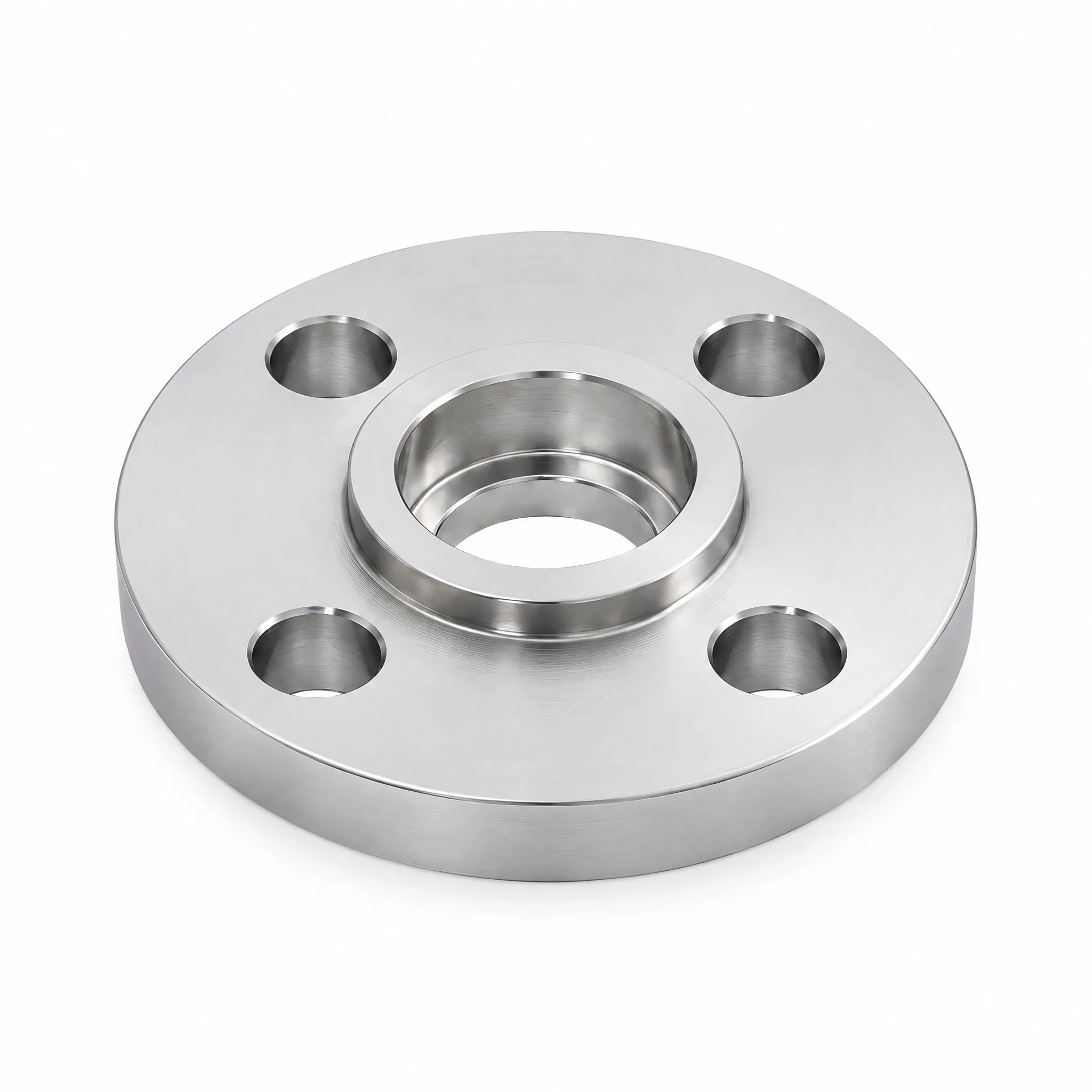
Size & Pressure Class Range
- Sizes: NPS 1/2 through NPS 4 per the ASME B16.5-2025 dimensional tables — socket-weld flanges are not provided at NPS 6 and above
- Pressure classes: Class 150 through Class 2500
- Typical use: instrument lines, small process piping, high-pressure small-bore runs where a butt weld would be impractical
Pressure-Temperature Ratings (Group 1.1 Carbon Steel, at 38°C)
| Class | 150 | 300 | 400 | 600 | 900 | 1500 | 2500 |
|---|---|---|---|---|---|---|---|
| Rating, bar | 19.6 | 51.0 | 68.0 | 102.0 | 153.1 | 255.1 | 425.1 |
Materials & Temperature Limits
| Material | Grade | Temperature Range |
|---|---|---|
| ASTM A105 | Carbon steel forging | -29°C to 425°C |
| ASTM A182 | F304 / F304L / F316 / F316L | Up to 538°C |
| ASTM A350 | LF2 | -46°C to 425°C (low-temperature service) |
Dimensions
Socket-weld flange dimensions — outside diameter O, minimum thickness tf, hub diameter X, hub length Y, socket bore B2 and socket depth D — are listed in the per-class dimensional tables of ASME B16.5-2025: Table 8 (Class 150), Table 11 (Class 300), Table 14 (Class 400), Table 16 (Class 600), Table 18 (Class 900), Table 20 (Class 1500) and Table 22 (Class 2500), SI units. The socket counterbore leaves a small gap at the bottom of the socket to avoid weld interference.
Related Standards
- ASME B16.5 — Pipe Flanges Overview (NPS 1/2–24)
- ASME B16.5 Weld Neck Flanges
- ASME B16.5 Threaded Flanges
- ASME B16.11 — Socket-Welding & Threaded Fittings
- Our Flange Range
- ASTM A105 Carbon Steel Forgings
- ASTM A182 F316 Stainless Steel
FAQ
What sizes do socket weld flanges come in?
ASME B16.5-2025 lists socket-welding flanges from NPS 1/2 up to NPS 4. They are a small-bore product — you will not find socket-weld flanges at NPS 6 and above.
How does a socket weld flange work?
The pipe slides into a machined socket in the hub, and the joint is made with one fillet weld around the socket opening. A small gap at the bottom of the socket prevents the weld from locking the pipe.
When would I choose socket weld over threaded?
Socket weld gives a stronger, more leak-tight joint than threaded ends and avoids thread galling; threaded flanges are chosen where welding is prohibited or disassembly is frequent. Both are small-bore connections.
What pressure classes are available?
Class 150 through Class 2500. Their high-pressure small-bore rating makes SW flanges common in Class 300 and above instrument and process service.
Which materials do you supply?
Forged A105 carbon steel, A182 F304/F316 stainless steel and A350 LF2 low-temperature steel, machined with socket bore and fillet weld preparation to ASME B16.5.