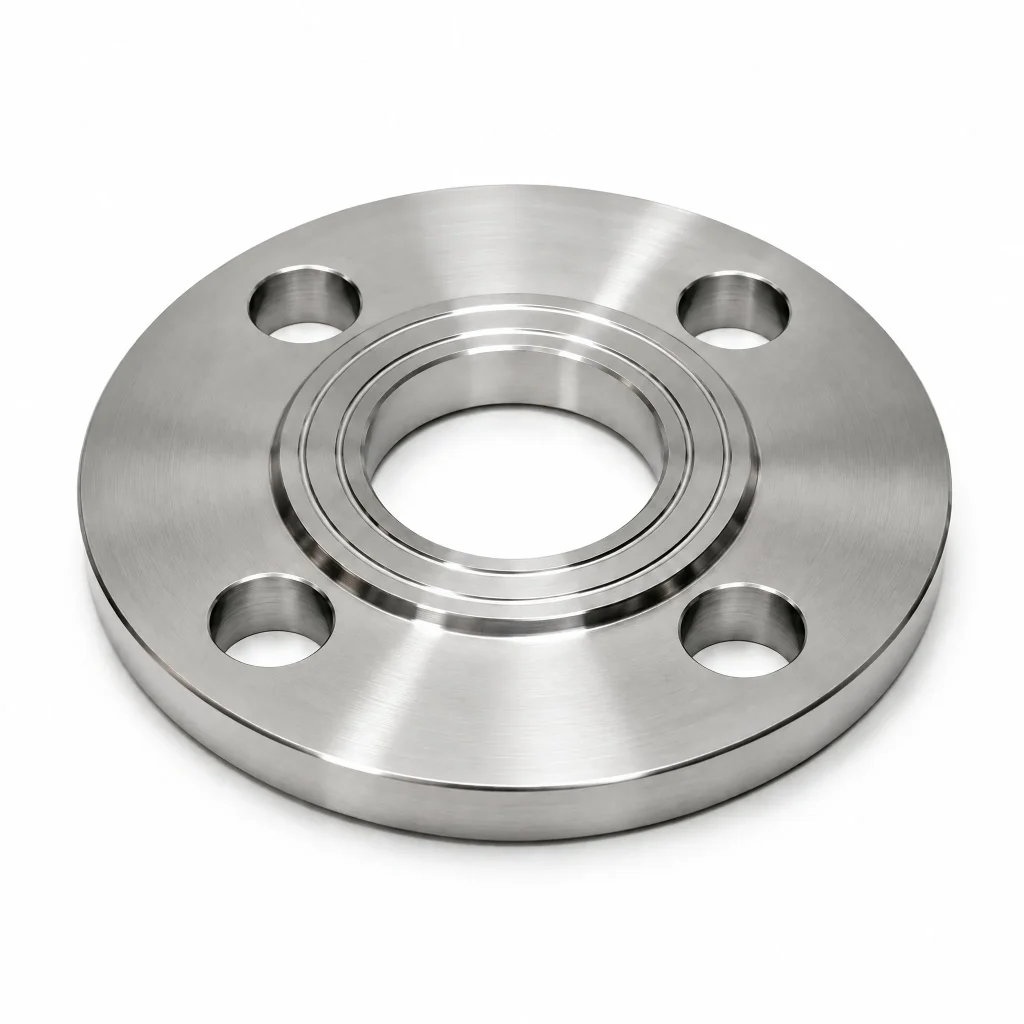
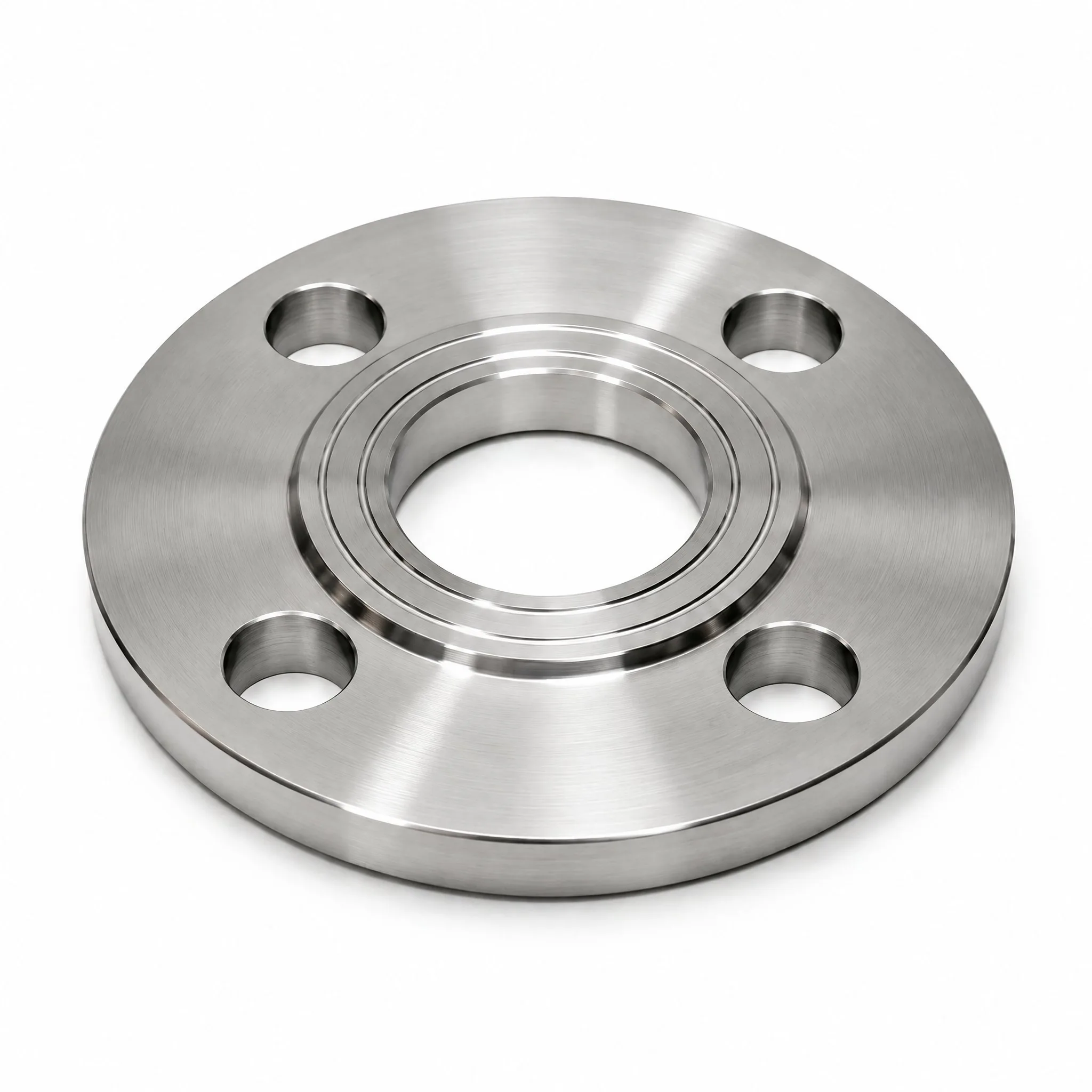
Plate Flat Weld Flange
Product Description
A cost-effective flat-plate flange, fillet-welded to the pipe. Also known as Slip-On Plate Flange, widely used in low-pressure, low-temperature applications.
Every flange is supplied with a mill test certificate (EN 10204 3.1), material traceability, and optional third-party inspection (BV / SGS / TUV). Available in Raised Face, Flat Face, and Ring Type Joint configurations per ASME B16.5.
Applications
Plate flat weld flanges (EN 1092-1 Type 01, equivalent to DIN 2527) offer an economical flanged connection for low-pressure, non-critical piping across water treatment, HVAC, and general industrial markets. They are fillet-welded to the pipe end and widely used in cooling water circuits, compressed air headers, sprinkler systems, and ventilation ducting where pressures remain at Class 150 (20 bar at ambient).
Typical applications include municipal water distribution networks, sewage treatment plant aeration piping, district heating loops, and agricultural irrigation systems. In commercial building construction, plate flanges connect fire pump headers, chilled water coils, and air handling unit duct transitions where cost is prioritized over fatigue rating.
They are also found in shipbuilding utility lines, food processing plant wash-down piping, and textile factory compressed air networks. Carbon steel A105 plate flanges service media from -29°C to 425°C; stainless F304/F316 units handle mild chemical and food-grade fluids.
Quality Assurance & Certification
Plate flanges are laser-cut or plasma-cut from certified steel plate and machined to EN 1092-1 Type 01 dimensional tolerances. Each batch is accompanied by an EN 10204 3.1 mill test certificate covering plate chemistry, tensile strength, and impact values. The manufacturer heat number is stamped on the flange face edge for material traceability.
Dimensional verification includes bolt circle diameter, bore diameter, face flatness, and bolt hole spacing per EN 1092-1 Table 6. NDT options include ultrasonic lamination testing on thick plates and dye penetrant on machined faces. Third-party inspection by SGS, BV, or TUV is available for European export orders requiring independent documentation.
All plate flanges receive anti-rust oil coating on carbon steel, plastic face protectors, and are strapped to wooden pallets for containerized sea freight. Each bundle is labeled with EN 1092-1 type designation, nominal size, pressure rating, material grade, and heat number for customs and site identification.
ASME Standard Data
Dimensional, pressure–temperature and material data transcribed from the ASME B16.5-2025 standard (NPS 1/2–24, Metric/Inch). Ratings shown for carbon steel Group 1.1 (ASTM A105) and stainless Groups 2.1–2.3 (A182 F304/F316 family).
1. Pressure–Temperature Ratings — Group 1.1 Materials (A105) — SI Units (bar)
Source: ASME B16.5-2025, Table 2-1.1 (SI Units). Notes: (1) Prolonged use above 427°C permissible but not recommended; (2) only killed steel above 455°C; (3) not over 260°C; (4) not over 371°C; (5) not over 343°C; (6) see para. 2.5.3 for minimum temperatures.
2. Pressure–Temperature Ratings — Group 1.1 Materials (A105) — U.S. Customary Units (psig)
Source: ASME B16.5-2025, Table 2-1.1C (U.S. Customary Units). SI and US tables are independently rounded per ASME practice.
3. Material Group Correspondence (ASME B16.5, Table 1.1-1)
Source: ASME B16.5-2025, Table 1.1-1 (Material Groups). “…” denotes not applicable in the standard.
4. Minimum Use Temperatures (ASME B16.5, Appendix G, Table G-1)
Source: ASME B16.5-2025, Nonmandatory Appendix G, Table G-1 (Example Minimum Use Temperatures). Impact testing requirements per applicable code.
5. Plate / Flat-Weld Flange Dimensions — Class 150, SI Units (mm, ASME B16.5 Table 9)
Source: ASME B16.5-2025, Table 9 (Class 150, SI). Class 300/400/600/900/1500/2500 dimensions also per Table 9. Full column set (incl. hub X and A_h) per standard.
ASME B16.5 does not list a separate ‘Plate’ flange type; plate/flat weld flanges are manufactured to Slip-On flange dimensions per Table 8.
Flange Dimensions — ASME B16.5-2025 Table 9 (SI Units, mm)
Complete flange dimensional data extracted from ASME B16.5-2025 (Pipe Flanges and Flanged Fittings), Table 9, for all pressure classes 150–2500. All values in millimeters (SI). Data verified against the ASME B16.5-2025 source corpus; the standard’s footnote numbering is preserved exactly.
Class 150 Flanges — ASME B16.5-2025 Table 9 (SI Units, mm)
Flange dimensions, NPS 1/2–24, 21 rows. Values in millimeters (SI).
Class 300 Flanges — ASME B16.5-2025 Table 9 (SI Units, mm)
Flange dimensions, NPS 1/2–24, 21 rows. Values in millimeters (SI).
Class 400 Flanges — ASME B16.5-2025 Table 9 (SI Units, mm)
Flange dimensions, NPS 1/2–24, 21 rows. Values in millimeters (SI). Rows marked * use the dimensions of Class 600 per Note (5).
Class 600 Flanges — ASME B16.5-2025 Table 9 (SI Units, mm)
Flange dimensions, NPS 1/2–24, 21 rows. Values in millimeters (SI).
Class 900 Flanges — ASME B16.5-2025 Table 9 (SI Units, mm)
Flange dimensions, NPS 1/2–24, 19 rows. Values in millimeters (SI). Rows marked * use the dimensions of Class 1500 per Note (5).
Class 1500 Flanges — ASME B16.5-2025 Table 9 (SI Units, mm)
Flange dimensions, NPS 1/2–24, 19 rows. Values in millimeters (SI).
Class 2500 Flanges — ASME B16.5-2025 Table 9 (SI Units, mm)
Flange dimensions, NPS 1/2–24, 20 rows. Values in millimeters (SI). NPS 14–24 are not included in the extracted corpus — see ASME B16.5-2025 Table 22.
Notes — ASME B16.5-2025 Table 9
- Note (5) — Class 400: Use Class 600 dimensions in this size. Values in rows marked * are taken from Class 600.
- Note (5) — Class 900: Use Class 1500 dimensions in this size. Values in rows marked * are taken from Class 1500.
- Note (6) — Class 900 / Note (8) — Class 300 / Note (9) — Class 150 (B column, NPS 14 and larger): To be specified by the purchaser.
- Note (5) — Class 600, 1500, 2500 (B column): To be specified by the purchaser.
- Classes 900, 1500 and 2500 do not list NPS 3 1/2 and NPS 22 in ASME B16.5-2025 Table 9.
- Class 2500 Table 9 covers NPS 1/2–12 in this dataset; NPS 14–24 refer to ASME B16.5-2025 Table 22.
- “—” = value not fully rendered in the extraction corpus (PDF text-layer conversion); refer to the standard original. Where a footnote text was truncated during extraction, the standard’s note numbering is preserved as-is.
- Blind (blank) flanges: hub and bore columns (X, Ah, Y, T, B2/B1/B, r, Q, D) do not apply; the O and tf columns remain valid.
- Socket-welding flanges cover NPS 1/2–4 per ASME B16.5-2025; rows above NPS 4 apply to the other flange types (WN / Threaded / SO / Lapped / Blind).
Stainless Steel (Group 2.1) Pressure–Temperature Ratings — ASME B16.5-2025
Pressure–Temperature Ratings, Group 2.1 Materials (18Cr-8Ni / 18Cr-8Ni-Mo) — ASME B16.5-2025 Table 2-2.1 (SI Units, bar)
Material designations in Group 2.1 — austenitic stainless steels (F304, F304H, F316 and related forgings, castings and plates). Working pressures in bar by class; values for temperatures in °C.
Notes — ASME B16.5-2025 Table 2-2.1 (Group 2.1)
- Group 2.1 covers 18Cr-8Ni (e.g. A182 F304, A351 CF3/CF8, A240 304) and 18Cr-8Ni-Mo (e.g. A182 F316, A351 CF3M/CF8M, A240 316) austenitic stainless steels.
- Working pressures shown in bar (SI units). Class 150 rating at room temperature is 19.1 bar, Class 2500 is 414.3 bar, per Table 2-2.1.
- The Group 1.1 (carbon steel A105 / WCB) ratings are provided in the earlier section of this page.
- “—” = value not fully rendered in the extraction corpus; refer to the standard original.
- Data extracted and verified against the ASME B16.5-2025 source corpus; footnote numbering preserved as-is.
Request a Quote for This Product
Tell us your standard, size, material and quantity — our team will reply within 24 hours.
Frequently Asked Questions
Classes 150, 300, 600, 900, 1500, and 2500 per ASME B16.5 §2 Pressure-Temperature Tables. Ratings vary by material group and temperature.
Carbon steel ASTM A105, stainless A182 F304/F316/F321, and low-temperature A350 LF2. Alloy steels (A182 F5/F9/F11) available on request.
Yes — EN 10204 3.1 MTC, full material traceability, and third-party inspection (BV / SGS / TUV) upon request.